Tuesday, October 24, 2006

Dr. Vino Says Put Spain In a Box

I do love Dr. Vino's wine blog. I just wish I could take one of Dr. Vino's (Tyler Colman) classes at NYU. Alas, I am at the end of the highway in a coastal backwater, with no such educational opportunities nearby.

A month ago I bookmarked Dr. Vino's post, An Open Letter to Jorge:

Dear Jorge Ordonez, importer of wine from Spain,

Bring us a good bag-in-a-box.

Robert Parker may have just sung your praises in his most recent newsletter. He may have lauded some of your top wines such as El Nido with 97 points.

But you also have many great value wines ranging from Tres Picos, to Naia, to Juan Gil. Borsao is great juice for $6 a bottle. You need to put it--or something like it--in a bag in a box. There's certainly no lack of old vine grenache in Spain that rolls in at value pricing. Tap that wine glut.

Dr. Vino's wine blog: September 2006


The letter goes on to point out that boxed wine is the fastest growing segment of the business, and that box wine has great advantages for restaurants.

Dr. Vino knows there is good wine in boxes, and he knows there could and should be more of it. Lots of good stuff on his most excellent wine blog; Dr. Vino should be on every wine lover's must-read list.

technorati tags: , , , ,

Let Taste Be the Judge

Jo and Tom Chesworth, both American Wine Society certified wine judges, have some good comments about boxed wines on the website of the Centre Daily Times (Central Pennsylvania).

Taste the bargains with boxed wines

If you ask most any wine enthusiast about box wine, he will say it isn't very good. And for what it's worth, that is usually true.

But, if you sneak box wine into a blind tasting -- one where the judges have no idea about the wine except what they can see and taste in the glass -- you often get surprising results. The box wine may be rated one of the best, and from time to time, it even walks off with the best of show award. What's going on here?

First, in our opinion, the best wine is the one that tastes best. You cannot tell the best wine by which grapes were used to make it. Nor can you tell by which country, nor climate, nor style, and you certainly can't tell by the price.

Granted, if you haven't tasted the wine, you can guess which ones are likely to taste good by these parameters, but they are indicators not determinants. To investigate the properties of box wine we must talk about both of its characteristics -- the box and the wine. They are independent.

The box is cardboard and it never comes into contact with the wine. It is a container to hold a plastic bag that is filled with wine. Millennia before glass bottles were invented wine was stored in bags -- bladders made from sheep stomachs or wine "skins."

Christ advised his apostles to not put new wine in old skins. Of course, Christ was not talking about wine, but the fact that he used this allegory indicates that the listeners were familiar with wine in bags.

As the bag empties, atmospheric pressure causes it to shrivel so that there is no air space -- air does not percolate back into the bag to fill a void left by the wine that was removed. Because there is no ullage, or air space, there is no oxygen to spoil the wine and no vinegar spores either.

The wine in the opened container will last unspoiled for 45 days. Keep it in the refrigerator. The low temperature will not hurt the taste and you can pour it 10 minutes before you drink it and have it be at the "right" temperature.

Does the plastic taint the wine? We think not. We look around the grocery store and see lettuce, sausage, cheese, milk and even spring water in plastic containers. If plastic did cause the wine to taste funny, the funny taste would show up in the spring water. If you go to Paris or Marseilles, you may be surprised to find liter plastic bottles of wine in the grocery stores.

The wine put into boxes generally is not the best quality, although some very good wine is beginning to show up in these containers. For instance, Cabernet Sauvignon, both red and white merlot, Chardonnay and "chillable red" among others are $12 to $17 for 5 liters or the equivalent of $2 for a 750-mililiter bottle -- Two Buck Chuck. Many of these wines are from California's central valley and are boxed by Franzia and Almaden among others.

There are also some more expensive wines available in boxes. Try Hardy's merlot, Chardonnay, Cabernet Sauvignon, Riesling and, of course, Shiraz, because Hardy's is in southeast Australia at $16 for a 3-liter box. Corbett Canyon, Black Box, Vella and La Tresor from California offer comparable box wines. We tasted a 2003 Block Wine Cabernet Sauvignon costing $12 for 1.5 liters. We found the wine intensely tannic (but that is a style -- one that we don't like, by the way) with a hint of fruit in the background. As promised, the small cubic box fit on the shelf in our refrigerator door.

A 3-liter Delicato Bota Box that sells for $17.99 and offers a choice of Merlot, Pinot Grigio, Shiraz or Chardonnay has won "best buy" awards for five consecutive years, 2001 through 2005, from Wine Enthusiast magazine. At the equivalent of $4.50 per 750 mililiters, these "award-winning premium quality California wines" are indeed a bargain.

Because there is no glass to break and because the wine is inexpensive, the vintners tout their boxed wines as being ideal for block parties, wedding receptions, picnics, camping or the beach. A neighbor tells us that they are great with meals at his hunting camp.

Hunting camp?

Jo and Tom Chesworth are both AWS-certified wine judges and can be found in the winecellar@7ms.com.

Centre Daily Times | 10/15/2006 | Taste the bargains with boxed wines


Right on, Jo and Tom!! It's very cool that the real experts are more open to the box. But I guess I should not be surprised that the trained nose and palate is able to judge objectively and set preconceptions aside.

Monday, October 23, 2006

State of Washington Asks: Is There Wine In That Box, or Is It "Wine"?

This situation has been brewing in Washington State for a couple of months. Looks like push may finally come to shove.

From Seattle Weekly, October 18.

Wine vs. 'Wine'

New to the job, and the governor's got you confronting a wine industry heavyweight. What's a Liquor Board president to do?

By Roger Downey

What a way to start a new job. No sooner than he was promoted to the post of supervising producers and wholesalers for the state Liquor Control Board, Jay Field got stuck last Wednesday with calling up one of the country's biggest and most powerful winemakers to ask if said winemaker was mislabeling its products.

So what kind of answer did he get from the Wine Group, manufacturers of the Franzia line of inexpensive boxed "table wine with natural flavors"? No surprise there; according to the liquor board's new PR person, Susan Reams, "We can't say anything about that because now we've talked to them, it's a regulatory matter under consideration, and we can't comment on regulatory matters under consideration."

Right. Still, the very fact that the state agency charged with protecting the consumer has actually initiated an investigation of misleading or deceptive marketing is, to use Reams' own word, "unique." Concerned consumers and wine-industry insiders alike have long complained that the Wine Group's Franzia products are not "wine" under the statutes and regulations of the state of Washington.

Reams says that the liquor board's investigation was set in motion by "a citizen complaint." It's questionable how much impact this complaint would have had if the board hadn't heard simultaneously from the director of the Washington Wine Institute, the staff counsel of Sen. Jeanne Kohl-Welles' powerful Labor, Commerce, Research & Development Committee, and the office of Gov. Christine Gregoire.

Why should it be so difficult to persuade a state agency to enforce its own rules about what can be called wine and what can't? One reason may be that "table wine with natural flavors" is a cash cow for the state's monopoly liquor stores: Four out of five of their top-selling wine-related products are sold under the Franzia label.

If the board sticks to its guns on this issue, it will make regulatory history, because until now, nobody, not even the fearsome federal Bureau of Alcohol, Tobacco and Firearms, has ever had the guts to take on the makers of beverages compounded of tap water, flavorings, grain alcohol, and, oh yes, some fermented grape juice, and threaten to deprive them of their God-given right to call the resulting mouthwash "wine."

A fair number of Washington winemakers are applauding (though not yet on the record) the accelerating campaign to restrict use of the plain word "wine" to beverages made from "the fermented juice of grapes"—period. Synthetic "wine" isn't a significant percentage of Washington production—yet. If the WSLCB does its job, it may never have to be.

Sips: Wine vs. 'Wine' (Seattle Weekly)


I have looked at the Franzia box labeling, and I believe a large segment of their product line is actually wine, and not "wine". The products in question are, I believe, those labeled as "table wine with natural flavors. I find the Franzia so-called "table wine" to be perfectly vile stuff, myself. It will be very interesting to watch this play out.

technorati tags: , , , , ,

Saturday, October 21, 2006

There Once Was a Cask Wine from Oz ...

This is good for a chuckle. From www.oedilf.com (The Omnificent English Dictionary In Limerick Form), a"definition" of cask wine (and chateau cardboard, to boot) in the form of a limerick:

"Chateau Cardboard?" he whiningly asks,
As he indicates one or two casks.
"Cab Sav? Or the white?
Try the red, it's orright.
What the booze lacks, the plastic taste masks."

(cab SAV): Oz shorthand for Cabernet Sauvignon.

The cardboard wine cask with its internal bladder was invented in Australia, as was its nickname Chateau Cardboard.

OEDILF


Of course, we now know that blind tasting has actually proven the "plastic taste" to be a figment of the imagination in the minds of anti-box snobs.


Friday, October 20, 2006

The Modern Pinnacle of Wine Packaging?

I loved this article in UnFiltered, the newsletter from The Wine Source, in Baltimore. I am fond of pointing out that marketing of wine in glass bottles is not a very old concept, less than 150 years according to this article. I suspect that the glass bottle brought wine into the homes of the common people. There are several reviews at the end, a number of nice wines in boxes, from acceptable to fastastic. Black Box 2005 Pinot Grigio got a raving thumbs-up! Repeat after me…the quality of the wine is not determined by the container it’s stored in.

CONTAINER LAWS

Tetra. Aluminum. Plastic. Glass.

All these new fangled materials are being used to store wines these days. No wonder the marketplace is confused.

And yes, glass is a new fangled product, at least in the history of wine. How new? Well, historical credit for the invention of glass blowing goes to the Romans, although glass was essentially a luxury item for centuries. The oldest wine bottle ever found has been dated to 321 A.D. But it wasn’t until 1821 that an English company patented a machine to mold bottles that were uniform in size and shape. Selling wine already bottled, however, was illegal in England until 1860, due to both the political influence of pub owners and the lack of both labeling standards and means of authenticating the fill volume. Relatively heavy and long lasting, glass has provided two distinct advantages for wine packaging; its chemically inert, preventing contamination; and impervious to oxygen, preventing spoilage.

So, glass is the ideal product to package wine in, right?

Well, uhm, no, not really. Since the primary purpose of any wine container is to transport, preserve and dispense, the modern pinnacle of wine packaging is, without question, the bag-in-a-box. It is lightweight, prevents oxidation of the contents over a reasonably long period of time, even when only partially full, and requires only a pinch to pour. No tools necessary. So, what’s the problem?

Image.

All right, maybe not image entirely. For collectors, one drawback is that the bag-in-box is probably not conducive to cellaring. I’m not really sure how a wine will age and mature in a poly-bag. I admit that this contention is purely speculative, and I am therefore curious about any research regarding the phenomenon. But for the rest of us, those that don’t plan on aging wines at all, it’s all about the image.

Or in other words, what would the neighbor’s think?

For many, wine choices are about image as much as price and taste. We all learned long ago that good wine was closed with a cork, not with a screw top or bottle cap. (Wrong about THAT, weren’t we!). Likewise, we learned that the stuff in boxes that our in-laws drank was swill. Guess what? Wrong about that as well.

Repeat after me…the quality of the wine is not determined by the container it’s stored in.

You want proof? Remember Charles Shaw wines, the famous Two-Buck-Chuck? That wine was produced by a guy named Fred Franzia. His family used to own Franzia. Fred, who’s a very bright guy, realized that many of us are trapped by our own wine stereotypes and he could make more money putting bag-in-box quality wine in bottle than by jumping back into the crowded bag-in-box market. The result? Charles Shaw wines were a huge success, purchased and applauded by those same snobs that wouldn’t touch bag- in-box wines! Fred laughed all the way to the bank (not that he needed the cash.)

Since then, the wine press is fond of talking about the revolution in boxed wines. As usual, their hyperbole doesn’t match the facts. Bag-in-box wines are a staple in Europe and Australia, as well as other places where wine choices are less status driven. The American wine industry is getting into the game because if they don’t, then French, Italian, Spanish and Australian bag-in-box wines will dominate the marketplace. Its not revolution, its economics.

But are today’s bag-in-box wines better than Fred Franzia’s parents’ wines? Well, sure, but so are most wines. There are more and better wines available on the market than at anytime in history. And its not because of Robert Parker or any other critic, either. Technology, both in the vineyard and cellar, has vastly improved winemaking and the tread towards planting in temperate climates has greatly improved vintage conditions. Oh, yeah, and containerized shipping has lowered the costs of shipping everywhere, and cheap (and unregulated) airfare has allowed the masses to travel more readily, and the Internet is making the spread of information easier and anyway, its always been true that…

…the quality of the wine is not determined by the container it’s stored in. Repeat after me.
2005 Oz Chardonnay South Eastern Australia TWS price $16.99 (4 liter) What to say (nicely!) about Aussie Chardonnay in a box…? Well, I’ve had worse Chardonnay from California for a lot more money in a bottle. No, no, scratch that! OK, OK…this is a typically ripe and juicy Chardonnay. It's got all that stuff that makes Chardonnay the most popular white wine in the USA; vanilla and caramel flavors, some creamy, buttery tones laying atop ripe pear and apples, limited acidity. The fact that it's in a box is frankly meaningless, you either will like this style of Chardonnay (and a lot of you do!) or you don’t. Me, I’m an acid- head, I like high acid Chardonnay from cool vintages, like 2004 Chablis…which is nothing at all like this wine. But, hey, it’s really not about me at all. I wanna know what you think! Well? (PW)
2005 Hugues Bealieu Petit Frog Picpoul de Pinet Languedoc, Southern France Regular price $24.99 TWS price $19.99 (3 liter) Little needs to be said about the quality of this perennially popular crisp white from the Languedoc Cooperative Hugues Bealieu. What is of note is their forward decision to package their irresistibly quaffable Picpoul in an affordable three-liter size box. This is a great box to have stocked in the fridge when your oh-so thirsty and oh-so wine- savvy neighbors stop by unexpectedly. Just tell them it’s a great little wine you discovered on your recent trip to the south of France. The truth is overrated anyway. (IAS)
2005 Black Box Pinot Grigio California TWS price $16.99 (3 liter) Black Box was one of the first successful producers of vintage dated box wine from California designed for retail shelves. They have struck pay dirt once again with their newly released remarkably vibrant 2005 Pinot Grigio. The rather translucent color belies a subtle creamy richness and varietally characteristic mineral note. Try this delicious wine next to a host of insipid mass-produced Italian Pinot Grigio and you’ll be shocked by the cleanliness and verve of this spectacular value. (IAS)
2005 Delicato Shiraz Central Coast, California TWS price $17.99 (3 liter) I have a grudge against Delicato, the really, really huge Central Coast producer that makes this wine. First of all, they call this wine Shiraz. I think that’s basically dishonest. I believe that they’re trying to confuse the market and make the consumer think that this wine comes from Australia. Well, it doesn’t. It comes from California, and in California the grape is called Syrah. I also don’t much like that they call their packaging a ‘bota’ box. Bota box? A bota is leather or animal skin bag that Iberian shepherds use to squirt wine into their mouths. Don’t try that with this product! Those annoying issues notwithstanding, this is very good wine. And, let me tell you, I hate having to admit that. I truly wish this wine sucked so I could let my bias against the stuff on the outside of the box win. Instead, I’m forced to admit that if you’re looking for Syrah from California, then you could do much, much worse than this wine. (PW)
2004 Castelmaure Corbières Corbières, France Regular price $35.99 TWS price $29.99 (5 liter) Of all our bag-in-box wines, this one might be the most un-exciting. Not because of the quality of the wine, mind you. The wine itself is fine, it's good; it's mostly Grenache from the beautiful Mediterranean facing vineyards of Corbières at the edge of the Pyrennes. It’s fresh, ripe (but not too ripe!) with nice herbal touches and a dash of black pepper. It’s un-exciting because the French have been making wines just like this and putting them into poly bags for twenty years or so. So what’s the big deal? It’s a very good value wine from the south of France. It just happens to be in a box, so it’s cheaper and lasts longer than most. Nothing exciting about that. (PW)
2005 Black Box Cabernet Sauvignon Paso Robles, California TWS price $16.99 (3 liter) Lets get one thing clear: it is hot in Paso Robles. The not just hot but dry climate produces Cabernet Sauvignons possessing intense fruit as well as a dusty, dry quality. While the 2004 Black Box Paso Robles Cab contains those qualities it also boasts a softness not often found in wines from this area. Try this delicious red with steak off the grill or pan fried Portabellas. Oh, and it comes in a convenient three liter box, so you can have it at your BBQ and also with the leftovers the rest of the week. (IAS)

winemail issue 17, August 23.p65


Again, repeat after me…the quality of the wine is not determined by the container it’s stored in.

technorati tags: , , ,

Tuesday, October 17, 2006

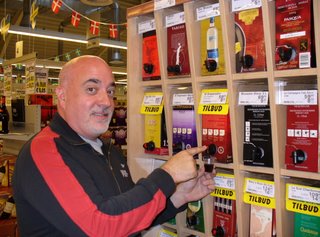
Can't We Have a Wine Tasting Wall?

I was completely amazed at the boxed wine sampling wall in Germany. It's a great concept! You certainly couldn't do that with bottles; they wouldn't keep! Is there any reason this could not be done in the US? Wine stores are allowed to have wine tastings, aren't they? I fear it the problem would be laws having to do with customers pouring their own, and it would require a full time employee to pour the customers' little thimbles-full.

technorati tags: , , ,

Monday, October 16, 2006

Boxed Wine Daytripping in Germany

Wow, look at this photo! It's the boxed wine tasting wall! This picture was posted on the Rhinocerus 1515 blog. Todd writes:
Here you see Dave taste-testing wine from a wall of wine boxes. We stopped at two stores (one big, one humongous) that cater to the Danish daytrippers. They can purchase apparently nearly unlimited amounts of alcohol at cheaper German prices and then load up their vehicles and drive back to Denmark with it. Although boxed wine is pretty taboo elsewhere in Germany, Dave and I now know the exact store that must sell more than anywhere else in the country! They had hundreds of types from dozens of lands -- all in handy cardboard boxes with convenient carrying handles. Who would fuss with breakable glass and moldy corks again? :-)

Rhinocerus 1515

Now why can't I find the boxed wine superstore in the US?

technorati tags: , , ,