Wednesday, January 30, 2008

Castillo de Fuendejalon 3 Liter Box

This is what we were drinking a couple of weeks ago.

Castillo de Fuendejalon (Fuendeyalon)
Bodegas Aragonesas
Imported by the Marchetti Company, Scoperta Importing Co.
Spain, Campo de Borja region
3 liter box, NV
about $14 - $19
Rich and full-bodied red wine with a nice balance of fruit.

• Color: Rojo cereza picota, con ribetes de juventud, limpio y brillante.
• Aroma: Aromas de fruta roja madura, perfectamente integrado con un suave carácter balsámico y de especias.
• Boca: Equilibrado, sabroso, con taninos maduros en el paso de boca. Final potente, amplio, con nobles recuerdos aromáticos como en nariz.
Bodegas Aragonesas

From the box:
OAK AGED
From selected grape varieties traditional to the area.
HARVEST: Second week of September
WINE MAKING: Traditional method, maceration with its skins during six days at 24C. After a deposit-maturing period the wine is aged in American oad casks for three months.
75% Grenache, 25% Tempranillo
Campo de Borja red tabel wine
Estate bottled - product of Spain
alcohol 12.5%
This is the same wine that is available in vintage dated bottles. I bought it at Surdyk's in Minneapolis for about $19, and brought it back to North Carolina. It's also available at Sam's in Chicago for about $14, and just recently was stocked at the Wine Store in Beaufort, NC.

We will definitely buy this again. The reviews and tasting notes I have found are for the vintage dated bottles, which are very popular sellers.

Dr Vino, September 9, 2005, Dr Vino's Wine Blog (2001 bottle)
But it’s not the outside that’s important since the inside holds a pleasantly oaked, medium bodied red with notes of dark fruits and violets. A blend of old vine greache and tempranillo, this wine’s packaging makes it ready to hit the road and bring to friends at the grill.

Dr Vino’s wine blog » Blog Archive » Value vino list fifteen


Thursday, January 17, 2008

New Tap Design Improves Shelf Life

From Off Licence News (UK):

Four-month shelf life for bag-in-box wines

Published: 28-09-2007
Written by: Graham Holter

Bag-in-box wine could stay fresh and drinkable for more than four months, according to a manufacturer who has developed a new type of tap.

Worldwide Dispensers' new ViniPlus system boasts a "greatly improved oxygen barrier" which enhances shelf life far more effectively than current designs, it claims.

The company added: "As well as its shelf life properties, the new tap offers a number of consumer convenience features. A self-closing, one handed front push button enables precise control of the direction and flow of the wine and the tear away cap around the button provides effective tamper evidence. In addition, a special valve seals the outlet after every use, preventing hang up in the spout."

Recent research from Wine Intelligence and the Wine & Spirit Trade Association has found that half of UK wine drinkers would buy bag-in-box wines for a party, but one in five said they would not buy them under any circumstances.

Most people who reject them find the packaging unappealing, though 17 per cent said they believed the wine would not be kept in good condition.

Four-month shelf life for bag-in-box wines | Off Licence News - The Voice Of Drinks Retailing


Technorati Tags: , , , ,

Thursday, January 03, 2008

Going green with the box in England

According to this article from Reuters, attitudes towards boxed wine are changing in England, although there is still resistance to the alternative forms of wine packaging.

Bagged or boxed? - Wine targets green shoppers

By Sylvia Westall
LONDON, July 18 (Reuters) -

Set the dining table, light some candles and crack open a nice bag of wine.

Serving guests wine from a plastic pouch or box may no longer be a social faux pas, say some in the wine industry -- as consumers warm to packaging that is seen as kinder to the environment than glass bottles.

"At the moment, these are seen as a niche packaging format," said Kate Coleman, spokeswoman for Britain's Wine and Spirit Trade Association, commenting on the new types of packing.

"But take screw caps -- people have grown used to them and now find them very acceptable."

Unlike with most materials, recycling some types of glass can produce slightly more harmful greenhouse gases than if they were thrown away, according to preliminary research commissioned by the Waste and Resources Action Programme (WRAP).

WRAP, a government-funded body, is also researching whether the new forms of wine packaging have environmental benefits.

But some wine companies, perhaps scenting the potential of the 'green' consumer market, are hoping to shake off the image of boxed or bagged wine as poor quality.

Wine company Ehrmanns is working with its South African exporter to launch a plastic wine pouch in mid-August.

The pouches will be filled with two-bottles' worth of its 'Arniston Bay' brand of white Chardonnay or Rose.

"There's so many foodstuffs, like soups, where you get premium products ready in pouches, so the pouch has got a very strong premium element," said Johan Hewitt, brand and business development manager at The Company of Wine People, which is exporting the wine.

Hewitt estimates 200,000 pouches will go on sale for about 9.49 pounds ($19.28) in Britain's Tesco supermarkets, and will be aimed at beach-goers and barbeque enthusiasts.

Even though the pouches cannot be easily recycled, the company says their carbon footprint is 80 percent smaller because the lightweight packs use less energy to produce and transport.

Similarly, Trinchero Family Estates, a California-based wine producer, sells some of its wine in slim purple boxes, which it says are more environmentally friendly to transport.


QUALITY CONTROL

The total UK market for bag-in-box wine stands at 390 million pounds, with a steady annual growth of 2 percent, according to Tesco.

In its own stores, Tesco says the bag-in-box category represents the 5th biggest section in wine behind bottles from Australia, France, the U.S. and Italy.

But shoppers outside a supermarket in central London were unsure new 'green' packaging could give wine a premium image.

"Opening a bottle is social occasion," said Xavier Bonnard, a 35-year-old French banker loading up the top box of his motorbike with shopping.

"Maybe it will be like people driving electric cars -- if it looks nice then people will eventually accept it. But not now, no, no."

Statistician Nadine Seeward, 34, who said she usually spends between 5-11 pounds on a bottle of wine, was also dubious.

"The connotation is that wine in a box is really poor quality, so you would have to change attitudes," she said.

"I'd have to taste to see if it was of the same quality."

Supermarket Waitrose says it is nonetheless also looking into stocking more wines in alternative packaging.

"The category is growing, which we think would at least in part be due to the better quality inside the pack," a spokeswoman said.


BOTTLES FOREVER

For those who work with wine, the problem is not the taste of wine in alternative packaging but its persistent negative image.

"The quality of bag-in-box wine has improved tremendously in recent years. But I think the perception of the consumer is very different," said professional wine taster Susan Hulme, from the Association of Wine Educators.

She said wine in the new forms of packaging would compare well to bottles from the cheaper end of the wine market, which each cost 5-7 pounds.

Increased environmental concerns, however, did not signal the end for the glass bottle.

"I can't see some of the very prestigious, very famous wines going into bag-in-box in the near future," she said.

While some wine companies use their packaging to attract environmentally conscious customers, WRAP stresses the country of origin is key to the product's carbon footprint.

"The UK market is important as 98-99 percent of our wine is imported," WRAP said in a statement.

FEATURE-Bagged or boxed? - Wine targets green shoppers | Reuters


Technorati Tags: , , , ,

Wednesday, December 12, 2007

It had to happen

Bag in box, without the box. From Arniston Bay Wines in South Africa comes a 1.5 litre pouch:

Take it easy with Arniston Bay wines in pouches

Just in time for the party season, Arniston Bay wines have laid up a surprise for wine lovers. They are presenting two of their fine wines in new easy to carry resealable 1.5 litre lifestyle pouches, holding twice as much as a traditional bottle at a fraction of the weight. The good news for those who are concerned about the environment is that Arniston Bay’s pouches have 80% less of a carbon footprint and take up 90% less landfill compared with a glass bottle equivalent.

Party goers and outdoor enthusiasts who want their wine in lightweight, easy to carry packaging can now take it easy. As can spectators at events where alcohol is permitted only in non-glass containers. Quick chilling, the pouches look good enough to serve with pride to friends at home.

Top selling

Arniston Bay Chenin Chardonnay 2007 is a masterfully blended white wine with lovely pineapple and ripe melon aromas and flavours of fresh lime. Delicious served chilled on its own, this wine is versatile with foods like salads, barbecued fresh fish or grilled chicken kebabs.

Arniston Bay Pinotage Rosé 2007 is as evocative on the eye as it is on the palate where delicious strawberry and violet flavours entice and then gently linger. Excellent served chilled as an aperitif, or with grilled prawns, salads and cocktail snacks.

Arniston Bay - Escape to Arniston Bay


Peter May at the Pinotage Club blog reports that at the Morrison's supermarket chain in the UK, where the pouch was trialled this fall, sales were exceeding expectations.

Tuesday, December 04, 2007

Delicato Announces Bota Box Goes Green

The newly redesigned Bota Box from Delicato Family Vineyards is showing up on the shelves. It appears that Delicato is spinning off the Bota Box Wines as a seperate product line, distancing it from the Delicato name. I searched for "Delicato" on the box, and if it was there, it was well hidden. I did not find it.
Bota Box Wine Goes Green

NAPA, Calif., Oct. 1 /PRNewswire/ --

In a response to a growing consumer demand for Eco-friendly products, DFV Wines announced today that their successful Bota Box wines have received an extreme green makeover with a new look. The award winning Bota Box is a 3 liter wine in a box with a new package that is more environmentally-friendly from a container that is made with 95% post consumer fiber and the box is recyclable. The print on the package is now done on unbleached Kraft paper and the ink used is water based versus petroleum based and the paper layers are held together with cornstarch instead of glue.

As a leader in the fastest growing category in the wine industry, Bota
Box is vintage dated and is available in the five popular varietal types:
Chardonnay and Pinot Grigio for the white wine offerings; Merlot, Shiraz,
and Cabernet Sauvignon for the red wine selections. Bota Box is available
nationally and the suggested retail price is under $20 in most markets. The
Bota Box borrows its name from bota bag, the old world custom of
transporting a beverage in a pouch usually made from an animal skin which
became quite popular in the '60s and '70s to concert goers, hiking
enthusiasts, campers, and other outdoor recreations.

"DFV Wines are committed to the consumer. Bota Box is one of the ways
to respond to wine drinkers that choose an eco-friendly package that is
convenient as well," says Chris Indelicato, CEO - President. "Our family
winery is dedicated to sustainable farming, smart winemaking, and
responsible marketing and we believe that our new Bota Box is the right
package at the right time."

DFV Wines has farmed premium vineyards in California and produced wine
for over 80 years. It continues to be family owned and operated by the 2nd
and 3rd generation Indelicatos. DFV Wines include Bota Box, Clay Station,
Delicato, Gnarly Head, Irony, Joe Blow, King Fish, Loredona, 337, Twisted,
and Chateau Maris.

Bota Box Wine Goes Green


Technorati Tags: , , , , ,

Friday, November 02, 2007

Boxed Wine Growing in Popularity Since 2002

This is from Wines & Vines, May 2002
Is it time for wine boxes? - bag-in-box wine growing in popularity
Wines & Vines, May, 2002 by Larry Walker

Tony Norskog, owner and winemaker of Nevada County Wine Guild in Nevada City, Calif., has a challenge for some daring Napa County winemaker: Bag it. That is, put a Napa County Cabernet Sauvignon in a bag-in-box. "The first Napa County Cabernet Sauvignon sold in bag-in-box will reap a million dollars in publicity," he said.

Norskog is something of a pioneer himself when it comes to bag-in-box. His 1.5 liter Our Daily Red is, as far as can be determined, the first organic wine ever to be sold in a bag-in-box.

I admire his courage (and his wine, too), but it must feel kind of lonely out there. People in the wine trade know that most U.S. wine sold in a box is, to put it mildly, not likely to win any gold medals. The attitude in California (unlike Australia) seems to have been "any wine will do as long as it hasn't actually turned to vinegar yet."

But there are signs that may be changing. Jon Fredrikson of Gomberg, Fredrikson & Associates noted that the overall market for bag-in-box in 2001 grew about 2%. However, the interesting numbers are for box varietals. White Zinfandel grew by 14%, and on a small base, box Chardonnay grew by 16%. There is a new box Shiraz from Franzia, and Franzia and Almaden box Merlot are both doing well, Fredrikson said.

Also, he believes that the average consumer seeking value is attracted to the 5-liter box where wine can be found that would cost only about a $1.60 a bottle in a 750m1.

"We have an enormous supply of wine around now, waiting for somebody to come out with a good quality wine, even if it was priced at the equivalent of $3 a bottle," he said.

Fredrikson said that technically bag-in-box is better than ever as a means to keep wine fresh. "I guess the paradox is that even though it is a good package, people in the United States won't pay more because of the box image."

Fredrikson said that 17 million units (5-liter bags) were sold in food stores last year at a dollar value of about $171 million. Fredrikson estimated that the 5-liter bag accounts for 95% to 98.5% of the market.

The Major Players

The three major players in the market are Franzia (which has a number of different labels), Canandaigua (Almaden) and Gallo's Peter Vella. Industry sources calculate that Franzia holds some 60% of the market; Almaden, 22%; and Vella, 17% but moving up fast. In fact, Peter Vella appears to be the leader in the White Zinfandel and Chardonnay market segments.

On Jan. 1, 2001, a change in regulations led to a major change in the market, Fredrikson said. Until that time, the "other special natural wines," which are wines with added flavoring and no minimum actual wine content, were allowed to list a wine varietal on the box. "The big story last year was the loss of that market," he said. "When they had to conform to minimum varietal labeling standards, Gallo jumped it."

Norskog said his organic box was selling well. When I spoke to him in February, the product was sold out in the San Francisco Bay Area. But it has the advantage of following the success of Our Daily Red in a bottle, which sells for about $6 on the West Coast and about $8 on the East Coast. The wine is made from Central Valley organic grapes. No sulfites are added, and the wine has good distribution in natural food stores.

Asked why he went for the box technology, Norskog said, "I've always thought the box was an abused package. Look at Australia and how well they do with 'cask' wines. It just has a low quality image in the U.S."

(Our Daily Red is a blend of Carignane, Cabernet franc and Carmine. It's a deep red color with lively blackberry and black pepper spice on the nose; it's medium weight in the mouth, with added dark berry fruit and a lingering finish. In short, a wine that I would be happy to have in my glass anytime. Or in my bag.)

Norskog added that the trade itself has more bias toward the package than the consumer. "You know, in the U.S., we have to sell wine three times. First to the distributor, then to the store and finally to the consumer. Only about half of my distributors picked it up, then about half the stores picked it up. That's one problem I'm facing," he said.

"I think the consumers really appreciate it for what it is. They can buy a box wine and drink a glass a day or a glass a week," Norskog said. He said he has tested the package and found the wine was still good a year after being put in the box.

Norskog said he had not made a decision yet about continued use of the box despite some success in the market. "The cost of producing one 1.5 liter package equals the cost of bottling a case of bottles," he said. Each box must be assembled manually, another person fills the interior bag and another stuffs it into the box and glues the box shut--a labor-intensive operation for sure. Norskog uses a Scholle AF900 semi-automatic, single-vale filler and a DuraShield 45 Scholle bag. Norskog admitted that it would make more sense from a labor standpoint to use a larger box size, 3 or 5 liter. "But I decided on the 1.5 to keep my price under $10," he said. "On a larger box, I would have better margins, but will people spring for an $18 box of wine?"

French Going for Bags

There is apparently a growing market for box wines in France, both for the national market and export market. According to Roberta Morris of Scholle, the French bag market is currently only 1% of the wine market, but on a volume basis, it's almost as big as the U.S. market. The 3-liter package tops the market in France, though there are also 5-liter boxes and 10-liter boxes, sold mostly for home consumption. Scandinavia and the United Kingdom are major markets for French box wines. Morris said Scholle had also been pitching box wines for use in wine-by-the-glass programs.

In Australia, truly premium wine is sold in 2-liter boxes, and the 5-liter box is known as the party box. The 10-liter size is also popular.

Morris said that Scholle is looking for a mid-sized California winery to use bag-in-box to break into a new market and help create and expand the wine market.

Scholle is introducing a new clear film for their bags called Dura-Shield45. Morris said the new film provides better protection and extended shelf life for the wine. The Scholle bags also have a new dispenser called the FlexTap, which Morris says is durable and easier to use.

Christophe de Carbonnieres, the business development manager with Smurfir Bag-in-Box USA, says his company is one of the only companies to offer a one call bag-in-box package. Smurfit can do the whole number, from graphic design to the final product ready for the retail shelf, including the box, the bag and the pour spout. The company, which was formed in Europe, has been in the U.S. market for about tow years.

"We really feel that the winemakers in the U.S. will come to realize that bag-in-box packaging can be used to serve wine lovers and the food service industry here, just as it does in Europe, Australia and Canada," he said.

He said that the Smurfit product has a shelf life of at least 10 months and will keep the wine fresh six or seven weeks after opening. "We are trying to make the U.S. wine industry understand that bag-in-box packaging can be very successful, especially in a wine-by-the-glass program, for example," he said in a telephone interview.

Another plus for bag-in-box packaging mentioned by several suppliers and producers is the opportunity for added graphics and information to be displayed. For example, the entire box turns into point-of-sale for Our Daily Red. The graphics are attractive, and winemaker Norskog uses the back of the box to point out the advantages of buying wine in a box and explains just what organic grape growing is. The best wine marketing tells a story about the wine, and Norskog's package does just that.

Bag-in-Box Market Share for 2001

PRODUCT % OF MARKET

White Zinfandel 17
Chablis 17
Other Special Natural 16
Blush chablis 13
White Grenache 11
Chardonnay 8
Merlot 3
Cabernet Sauvignon 3
Other 12

Source: Gomberg, Fredrikson & Associates

RELATED ARTICLE: Putting It In A Box

Bag-in-box wines would be a mess without boxes, and Pacific Southwest Container is one of the major suppliers of boxes. According to Brian Smith, executive vice president and sales manager, the company makes the boxes for Gallo, Canandaigua and The Wine Group.

The company has a graphics department, although Smith said most wine companies did the graphics design. Smith said there is a constant effort to make the box more user-friendly and to work with wineries to increase the impact of the graphics.

"I know there are some wineries now researching and testing putting good quality wines in bag-in-box," Smith said. "There is a movement toward better quality."

Pacific Southwest Container did the box for Our Daily Red from the Nevada County Wine Guild. For more information, contact Pacific Southwest Container at 4530 Leckron Road, Modesto, Calif. 95353, phone (209) 526-0444, fax (209) 522-8746 or visit the Web site teampsc.com.

Almaden Targets Japanese Market

In February, Almaden announced plans to introduce bag-in-box wines to Japanese consumers. To distribute the brand in Japan, Canandaigua Wine Company formed on alliance with Japan's Asahi Breweries, Ltd., which also serves as a major wine importer.

In a press release, Doug Kahle, VP of Canadaigua Wine's International Division, said, "we believe this product is being introduced at the right time in the Japanese market. Wine consumption is growing steadily in Japan, and consumers are looking for accessible, quality wines at affordable prices. For these reasons, we believe that Almaden Bag-in-the-Box will attract and satisfy consumers in this market."

Almaden bag-in-box wines will be available in 5 liters in both red and white wines.

Cribari Cooking Wine In A Bag

Canandaigua Wines has introduced an innovative box wine designed for restaurant kitchens. The Cribari Cellars 5-Liter Bag-in-the-Box offers a Marsala or Sherry style wine exclusively for chefs. The new culinary boxes build on the Cribari reputation for cooking wines, and the recyclable cardboard containers eliminate glass in the kitchen. The culinary bags also ensure that the wine stays fresher than it would in a bottle.

"We are very excited about Cribari Cellars 5-Liter Bog-in-the-Box," says John Heinz, vice president of National Accounts and On-Premise Sales for Canandaigua Wine Company. "Orders for the new package hove already been secured with independent restaurants and national accounts. Cribari Cellars 5-Liter Bag-in-the-Box is an affordable, easy-to-use premium cooking wine for every on-premise establishment."

Is it time for wine boxes? - bag-in-box wine growing in popularity Wines & Vines - Find Articles


Technorati Tags: , , ,

Wednesday, October 31, 2007

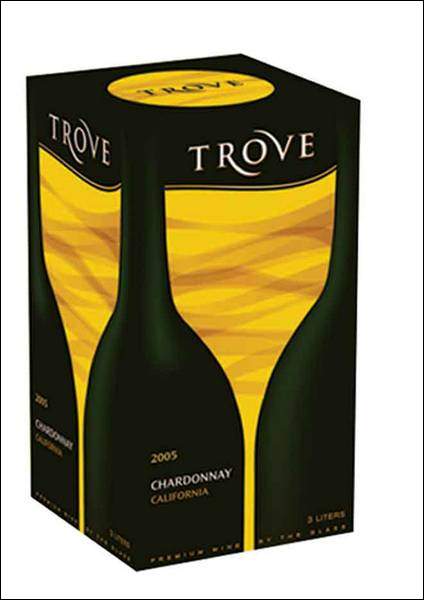
Trove Chardonnay 3 Liter Box

Another white wine addition to the list of bag-in-box wines:

Trove Chardonnay
Trove Wines (Centerra Wine Company, Constellation Brands)
California
3 liter box, vintage dated
About $19 - $23

2005 California Chardonnay. This stylish, delectable, medium-bodied Chardonnay, produced from choice North and Central Coast grapes, boasts creamy tropical fruit aromas and round, smooth flavors enriched by soft oak tones. Food Pairing Trove Chardonnay pairs beautifully with chicken satay, fried oysters, grilled garlic shrimp, fish tacos, tuna tartar and fettucine alfredo.


Reviews in the Press

Cindy Kibbe, Aug 18, 2006, New Hampshire Business Review
2005 Trove Chardonnay (Madera, Calif., 3L, $19.99): I’ve had premium bottled varietals that were not as good as this box brand. Made from 100 percent Chardonnay grapes, this Trove truly was a treasure. The crisp grapefruit, lime and pineapple flavors were balanced with just the right amount of oak and buttery creaminess.

New Hampshire Business Review


Reviews on the Web

Jerry Hall, August 31, 2006, Winewaves blog
Trove Chardonnay Box 2005 - Tasting Notes: Color: Light golden straw. Roundly textured, rich, somewhat tropical aromas (think pineapple-upside- down-cake), somewhat oak-spiced, this Chardonnay is medium-bodied and has nice concentration. Alcohol content: 13.5%. Excellent value ($18/3.0 Liter = $4.50/750ml equivalent).

winewaves: Premium 3 Liter Bag-in-Box California Chardonnay: Trove 2005 & Delicato 2005


Kirk, August 14, 2007, All Four Seasons blog
Cool box, $18 for 3 liters (or four bottles worth), and a cute name (get it treasure trove???). They even claim to be "premium wine in a box" on their website. I have one word for that--NOT. Maybe I have more words. Never (and I mean never) have I had a worse wine that this. I'm not sure what monkey poop tastes like, but it likely tastes better than the Trove Chardonnay. The color was golden, the nose was putrid, and the taste was unfathomable--as in how the heck do they ever get anybody to try this stuff twice??? My only hope (for the vineyard, that is), is that this wine was cooked, causing me so much derision and (dare I say) pain...

All Four Seasons


technorati tags: , , , , , ,